 |
| Add caption |
"It is necessary to speak of beginnings..."
That particular phrase opens up on the first page far (not that far) before the Prologue section. And Alastair (or Al) closed the book with a good twinning phrase: "We spoke of beginnings, at the start of this. It is well now to speak of endings."
One of Al's bookfan mentioned that this is the only book which Al uses three words as a title: Revelation Space, Redemption Ark, Absolution Gap, Century Rain, Pushing Ice and many more. And another good (bad) news: it's a trilogy (of a sort).
There are a lot of trilogies out there swarming the bookstores, like The Hunger Games, or something as epic and classic as The Lord of the Rings. Al has his own trilogy in store: Revelation Space. But this time, it's different, I can tell that. The upcoming two more sequels are not really a direct sequel, but rather, lay in a much larger major plot line, or story arc. So don't expect continuous flow of reading. You can read the second book without the other three. It's semi-independent.
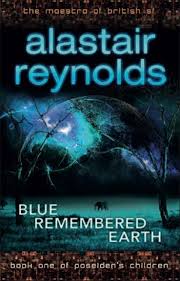
Blue Remembered Earth is a masterpiece of his works. I have all of his works. I read all of them, each with distinctive flavour, and this Blue Remembered Earth is the only book that made me want to cry. It has a happy sad ending, or sad happy ending, whichever you want it to be. But definitely not the sad kind in romance film, or which everyone dies in the end. It's a sadness of both nostalgic and awe that we are still babies in the universe.
The title itself struck me in my heart. "Blue remembered Earth". A pale blue dot in a vast cosmos. What have we, as humans, done to preserve it? Pollutions and wars. Business and industries. Where is the blue? Where's Earth?
Geoffrey and Sunday Akinya are the two main characters of the story, dotted by various interesting people like their cousin Hector and Lucas, as well as the Panspermian Initiative and the whale-woman. Set in the 2161 year, we can still find traces of our local tech, although economics have pushed as far out as to the Kuiper Belt. So, there would be no ridiculuous incomprehensible tech like teleport and time travel. You would feel comfy at home.
If you are too pushy on plots, this book could pose a danger to your mind because there are tonnes of new ideas "fizzing off every page". These new ideas do not relate properly to the storyline but actually serve as a base for the future two books, convincing readers that something like robotic organisms is not impossible. Some of the new ideas (spoilers!) include, well, robotic Darwinian evolution, dwarfing organisms and extreme bioenginnering of human bodies.
 Geoffrey and Sunday (siblings) are from Africa whereby it has bloomed to be a major economic force in the world, and they are the descendents of the powerful matriarch Eunice Akinya (their grandmother). When their grandmother died, she left clues for her family to pick up. Oh, and mind you, the first clue you stumble upon, Geoffrey was right.
The search does not end on Earth of Trans-lunar space, it goes beyond till the Kuiper Belt. The adventure doesn't end. The sightseeing doesn't end. Every time the characters go to a new place, you have to relax and breathe in the sea of words and description, particularly the underwater city of Tiamaat.
There are so many worlds: the savannah of Africa, the blue waters of Tiamaat, the grey-white of Moon, the arid red desert of Mars. The colours are so blinding that you would stay awestruck for few seconds.
Besides, Al made us ponder on issues like: is it our imperative to spread life across the universe? is a world free of crime good for society?
Speaking of free of crime, Al created a Mechanism for this book, an All-seeing God that would annihilate any possible crime in the entire solar system, except the Descrutinized Zone on the Moon where Sunday lives.
It's a book of wonder, no doubt. Wonder as in wonderful, or thoughtful. It meant both. Get the book now and start soaking yourself in a brand new way of story telling by Alastair Reynolds!
Visit his website here: www.alastairreynolds.com. You can even email him or blog-comment him. Further information can be found on his website.
Oh you want to know why I made this for Al?
Because I only love Al's story-telling and friendliness to readers!
Geoffrey and Sunday (siblings) are from Africa whereby it has bloomed to be a major economic force in the world, and they are the descendents of the powerful matriarch Eunice Akinya (their grandmother). When their grandmother died, she left clues for her family to pick up. Oh, and mind you, the first clue you stumble upon, Geoffrey was right.
The search does not end on Earth of Trans-lunar space, it goes beyond till the Kuiper Belt. The adventure doesn't end. The sightseeing doesn't end. Every time the characters go to a new place, you have to relax and breathe in the sea of words and description, particularly the underwater city of Tiamaat.
There are so many worlds: the savannah of Africa, the blue waters of Tiamaat, the grey-white of Moon, the arid red desert of Mars. The colours are so blinding that you would stay awestruck for few seconds.
Besides, Al made us ponder on issues like: is it our imperative to spread life across the universe? is a world free of crime good for society?
Speaking of free of crime, Al created a Mechanism for this book, an All-seeing God that would annihilate any possible crime in the entire solar system, except the Descrutinized Zone on the Moon where Sunday lives.
It's a book of wonder, no doubt. Wonder as in wonderful, or thoughtful. It meant both. Get the book now and start soaking yourself in a brand new way of story telling by Alastair Reynolds!
Visit his website here: www.alastairreynolds.com. You can even email him or blog-comment him. Further information can be found on his website.
Oh you want to know why I made this for Al?
Because I only love Al's story-telling and friendliness to readers!


